🏆 Kevin Durant's Villain Arc: From MVP to Most Hated
Kevin Durant's career is a study in how quickly public perception can shift. For nearly a decade, he was one of the most liked players in the NBA — a humble kid from Maryland who played with joy, scored with effortless grace, and seemed genuinely grateful for his success. Then, on July 4, 2016, he posted a short message on The Players' Tribune that detonated his reputation: he was joining the Golden State Warriors.
The OKC Years: Building Goodwill
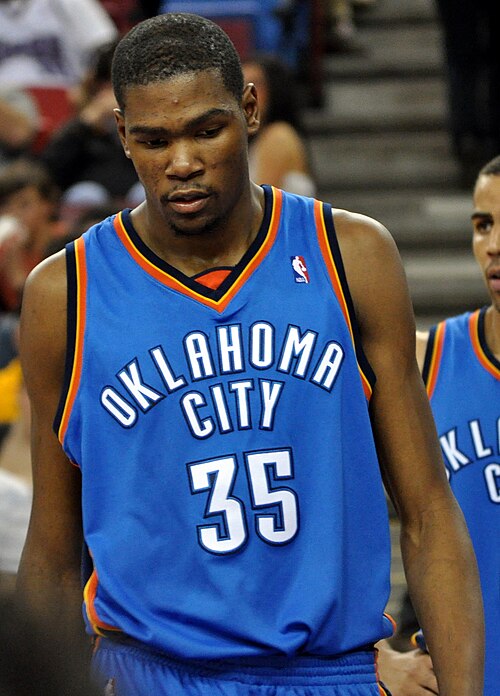
Durant arrived in Oklahoma City as a 19-year-old with a slight frame and an impossibly smooth jumper. Over nine seasons, he became the face of the franchise. He won four scoring titles, an MVP award in 2014, and led the Thunder to the NBA Finals in 2012. His "You the real MVP" speech — directed at his mother during the MVP ceremony — became a cultural moment. KD was beloved.
He and Russell Westbrook formed one of the most exciting duos in the league. They were young, dynamic, and seemed destined to bring a championship to Oklahoma City. When the Thunder took a 3-1 series lead over the Warriors in the 2016 Western Conference Finals, it appeared that destiny was about to be fulfilled.
Then they blew it. The Warriors came back to win Games 5, 6, and 7. Durant shot poorly in the final three games. The collapse was devastating — and it set the stage for the most controversial free-agency decision in NBA history.
The Hardest Road
On July 4, 2016, Kevin Durant announced he was leaving the Thunder to join the Golden State Warriors — the same team that had just beaten him, the team that had just set the all-time regular season record with 73 wins, the team that already had Stephen Curry, Klay Thompson, and Draymond Green. He was joining a superpower.
The backlash was thermonuclear. Oklahoma City fans felt betrayed. Basketball purists argued KD had destroyed competitive balance. Social media exploded with memes, insults, and the word "cupcake" — a reference to a Russell Westbrook-inspired diss. Former players weighed in. Charles Barkley called it weak. Even fans of other teams who had no personal stake felt disgusted.
The criticism centered on one argument: the best players should compete against the best, not join them. Michael Jordan did not join the Pistons after they beat him. LeBron at least went to a team that needed him. Durant joined a team that had just won 73 games without him. The math simply did not add up for anyone who valued competitive integrity.
The Rings and the Emptiness
The Warriors with Durant were exactly as dominant as everyone feared. They went 16-1 in the 2017 playoffs and won the championship easily. Durant won Finals MVP. They repeated in 2018. Durant won Finals MVP again. By every statistical measure, he was playing the best basketball of his career.
But the rings felt hollow to many observers. The Warriors were so stacked that the outcomes felt predetermined. The 2017 and 2018 Finals were competitive in moments but never truly in doubt. KD got his championships, but the narrative around them was always accompanied by an asterisk — he needed a 73-win team to get there.
Durant himself seemed aware of this perception, and it clearly bothered him. Which brings us to the most embarrassing chapter of his villain arc.
The Burner Accounts
In September 2017, Durant accidentally responded to a critic on Twitter from his own account — but in the third person. "He didn't like the organization or playing for Billy Donovan," Durant wrote about himself, clearly forgetting to switch to a burner account. The implication was clear: KD had been using fake accounts to defend himself online and attack his former teammates and coaches.
The burner account scandal was humiliating. Here was one of the greatest basketball players alive, a two-time Finals MVP, spending his time arguing with random Twitter users through fake identities. It revealed a level of insecurity that was staggering. The incident became a punchline that has followed Durant for years and added a uniquely pathetic dimension to his villain persona.
The Brooklyn Saga and Beyond
Durant left the Warriors in 2019 after tearing his Achilles tendon and joined the Brooklyn Nets alongside Kyrie Irving. The super-team experiment in Brooklyn failed spectacularly — injuries, Kyrie's vaccine refusal, James Harden's departure, and ultimately Durant's trade demand in 2022 created a circus that made the OKC departure look dignified by comparison.
KD eventually landed in Phoenix, then was traded again. The pattern of joining star-studded rosters, growing unhappy, and forcing his way out has become his defining characteristic. The same player who once gave a tearful MVP speech about gratitude now carries a reputation as one of the most restless and discontent superstars in league history.
The Verdict
Kevin Durant's villain arc is unique because it was entirely self-inflicted. No one forced him to join the Warriors. No one forced him to create burner accounts. No one forced him to demand trades from Brooklyn. Every step of his fall from grace was a choice — and that is what makes the hate so intense. Durant had everything: the talent, the hardware, and the public's affection. He threw it all away because 73 wins looked easier than building something of his own.