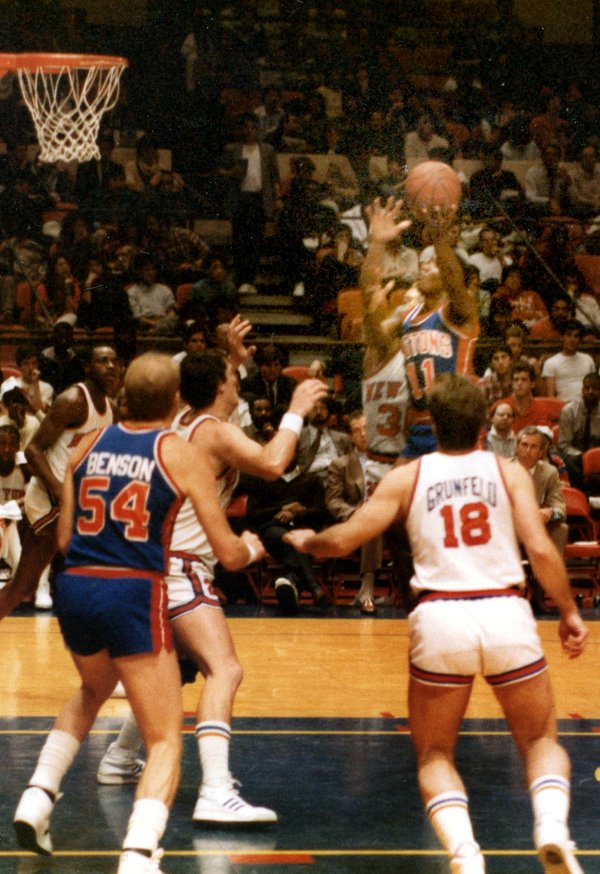
🏆 Bad Boys Pistons: The Blueprint for NBA Villainy
Before the Golden State Warriors had Draymond Green, before the Miami Heat had LeBron's super team, before anyone had ever heard the phrase "load management," there were the Detroit Pistons. The Bad Boys. The most feared, most hated, and most physically punishing team in NBA history. They did not just win two championships — they wrote the rulebook for how to be a villain in professional basketball.
The Cast of Characters
Every great villain story needs a compelling cast, and the Pistons had one for the ages:
- Isiah Thomas — The smiling assassin. A 6-foot-1 point guard with an angel's face and a killer's instinct. Isiah orchestrated the chaos with a grin that made opponents even angrier.
- Bill Laimbeer — The enforcer. The dirtiest player of his era and possibly any era. Laimbeer threw elbows, set illegal screens, and flopped before flopping was a thing. He was universally despised and absolutely loved it.
- Rick Mahorn — The intimidator. At 6-foot-10 and 260 pounds, Mahorn's job was to make opposing players afraid to drive the lane. He was terrifyingly effective.
- Dennis Rodman — The wildcard. Before the hair dye and the wedding dress, Rodman was a relentless defensive force who would crawl over broken glass for a rebound.
- Joe Dumars — The gentleman. Every villain team needs one honorable member, and Dumars was it. His sportsmanship made the rest of the team's behavior look even worse by comparison.
The Jordan Rules
The Pistons' most famous tactical innovation was the Jordan Rules — a set of defensive strategies designed specifically to neutralize Michael Jordan. The rules were simple: every time Jordan touched the ball, hit him. Hard. If he drove the lane, knock him to the floor. If he pulled up for a jumper, body him. If he dunked, make sure he felt it on the landing.
The Jordan Rules worked. Detroit eliminated Chicago from the playoffs three consecutive years — 1988, 1989, and 1990. Jordan, the greatest player alive, could not get past the Pistons' wall of physicality. It was not until Phil Jackson installed the triangle offense and the Bulls added Horace Grant and Scottie Pippen that Chicago finally broke through in 1991.
The genius of the Jordan Rules was not just their effectiveness — it was their psychological warfare. By targeting Jordan specifically, the Pistons sent a message to every other team: we will do whatever it takes. No player is safe. No star is untouchable. That mentality defined an era.
The Walk-Off
When the Bulls finally swept the Pistons in the 1991 Eastern Conference Finals, Detroit committed what many consider the ultimate act of poor sportsmanship. With eight seconds left in the final game, the Pistons' starters walked off the court without shaking hands. Isiah Thomas led the way, followed by Laimbeer, Rodman, and the rest.
The walk-off haunted the Pistons for decades. It was cited as a primary reason Isiah Thomas was left off the 1992 Dream Team. It tarnished their championships in the eyes of many fans and analysts. But it also cemented their identity — the Bad Boys did not play nice, did not pretend to respect you, and did not care what anyone thought. They were villains to the very end.
The Physical Toll
Modern NBA fans who have only watched today's pace-and-space style might not fully appreciate how brutal the Bad Boys Pistons were. Flagrant fouls were barely penalized. Hard fouls that would draw automatic ejections today were considered "good, hard basketball." Players like Laimbeer and Mahorn would clothesline opponents on fast breaks and receive nothing more than a common foul.
The Pistons' physicality eventually led to rule changes. The league cracked down on hand-checking, flagrant fouls, and excessive contact. In many ways, the beautiful modern NBA — with its emphasis on spacing, shooting, and player safety — exists specifically because the league decided it never wanted another team like the Bad Boys Pistons.
The Blueprint
Every NBA villain since has borrowed from the Pistons' playbook:
- Embrace the hate. The Pistons never tried to be liked. They wore the villain label as a badge of honor. Draymond Green, Patrick Beverley, and every antagonist since has followed this principle.
- Protect your own. If an opponent took a cheap shot at a Piston, the entire team responded. That collective toughness created a bond that championships are built on.
- Win anyway. Dirty play without winning is just dirty play. The Pistons backed up every elbow and every trash-talk session with two championship trophies. The rings validated the villainy.
The Bad Boys Pistons were not the first dirty team in NBA history, but they were the first to turn villainy into an identity, a strategy, and a championship formula. Every hated player who has come after them is following a blueprint that was drawn in Detroit.